
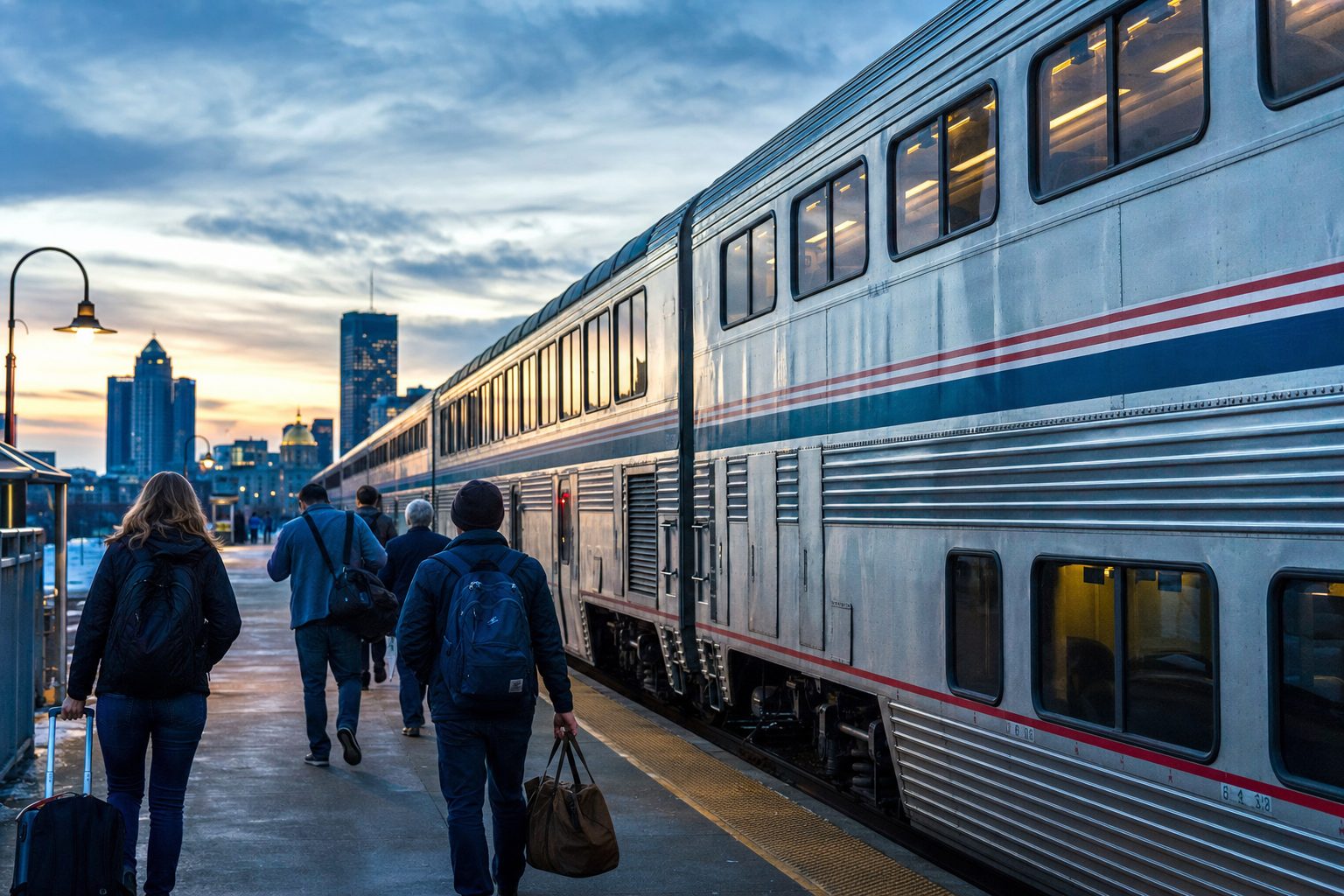
Amtrak’s Crescent joins two cities that usually appear on separate mental maps. New York is the vertical, hurried start; New Orleans is the low, humid conclusion. Between them, one daily train traces the Northeast Corridor, crosses Virginia’s Piedmont, enters the Carolinas, and continues through Georgia, Alabama and Mississippi. Amtrak describes the run as roughly 30 hours, while the current timetable is a little longer. Either way, it is not simply a slower substitute for flying. It is an overnight journey with a visible argument: the eastern United States is connected by gradients, not jump cuts.
The southbound train is number 19. It normally leaves New York in the afternoon and reaches New Orleans the following evening, but exact times can change. The useful planning unit is therefore not “one day on a train.” It is an afternoon, a night, a full daylight section and an arrival evening—each with different demands.
Think in phases, not mileage
The opening hours are operationally easy. Moynihan Train Hall is the origin, so there is time to locate the departure board and board without solving an intermediate-station stop. Philadelphia, Baltimore and Washington follow in quick succession. This is the most urban part of the route: platforms, viaducts, row-house backs, rivers and the busy infrastructure of the Northeast Corridor.
Washington is the hinge. The train changes locomotives there because the electrified corridor ends and diesel operation begins. Passengers usually remain aboard, but the stop can be longer than the earlier station calls. After Washington, the spacing opens. Virginia arrives around dinner and evening; darkness generally covers much of the Carolinas on the southbound run.
Morning resets the journey. Atlanta is the major daylight marker, followed by the industrial and wooded landscapes of western Georgia and Alabama. Birmingham comes around the middle of the second day, then Tuscaloosa, Meridian and Hattiesburg lead toward southern Louisiana. Seasonal daylight and delays alter exactly what is visible, so treat this as a sequence rather than a guaranteed viewing schedule.
What unfolds beyond the glass
The Crescent’s value is cumulative. The Northeast presents density as a near-continuous condition. South of Washington, the view begins to alternate among town centres, forest, open land and working rail property. The train serves places as different in scale as Charlottesville, Greensboro, Charlotte, Greenville, Atlanta and Birmingham before crossing smaller-city Mississippi.
Do not expect uninterrupted scenery in the manner of a mountain excursion. This is a transport route, and its subject is the inhabited landscape: warehouses, back gardens, university towns, road crossings, church steeples, kudzu, freight yards and stations that briefly gather a community around one platform. The approach to New Orleans is similarly practical rather than theatrical. Rail infrastructure and low-lying metropolitan edges precede the terminal.
That ordinary detail is the point. An aircraft makes New York and New Orleans feel adjacent. The train restores the chain of places between them. A paper route map, an offline map or a simple list of major stops makes the window more legible, especially where mobile reception becomes uneven.
Choose coach or a room by the night
Coach provides a reclining seat, legroom and access to the café. It can be a rational choice for travellers who sleep easily upright and can tolerate lights, announcements, boarding activity and neighbours moving through the car. The mistake is assuming that “reclining” means flat or private. It does not. Bring a compact eye mask, earplugs and a warm layer, and keep expectations closer to an overnight flight seat than a bed.
Roomettes have two seats by day and upper and lower berths at night, with shared toilets and showers nearby. Bedrooms provide more space plus an in-room toilet and shower. Amtrak includes meals for private-room passengers, along with attendant service; on the Crescent, the listed offer is Flexible Dining. Café purchases remain separate. Menus and service details can change, so dietary needs deserve a current check rather than an assumption.
The useful comparison is not only ticket price. Add the value of a horizontal night, included meals, privacy and the condition in which each option delivers you to New Orleans. A room does not make the ride luxurious by default, and coach does not make it punitive. They solve different versions of the same long night.
Pack for a moving day and a half
Build a small “seat bag” even if checking luggage: identification, medication, charging cable, power bank, water bottle, toothbrush, wipes, sleep kit, warm layer and food that does not require preparation. Keep it compact enough to manage without colonising the adjacent seat. Power outlets are provided, but a charged battery remains useful during interruptions or when a plug is awkward.
Amtrak currently allows one personal item and two carry-ons per passenger within published size and weight limits. Checked baggage is offered on the Crescent, but not every station handles it. A bag can only be checked when both the train and the relevant origin and destination support the service, and station cut-off times vary. Confirm the station pages rather than inferring from the route-level amenity.
Wi-Fi is listed, but no long-distance train connection should carry the full burden of a work deadline. Download tickets, reading, audio and maps before departure. Pack some food even if planning to use onboard service: delays can stretch meal intervals, and the café may not match a specific diet. Alcohol, smoking and prohibited-item rules are transport rules, not matters for improvisation.
Protect the arrival, not the timetable fantasy
Long-distance rail shares much of its route with host railroads, and delay is a material planning risk. Amtrak reported 62 percent customer on-time performance for the Crescent in calendar year 2024. That figure is not a prediction for any individual train, but it is strong evidence against arranging a tight New Orleans connection, a timed dinner or an event shortly after scheduled arrival.
Leave the arrival evening light. Save anything prepaid or difficult to move for the next day. If someone is meeting the train, share the live train status rather than a fixed pickup time. The same principle applies northbound: do not build a fragile flight or separate rail ticket immediately after the scheduled New York arrival.
Check service alerts before leaving for the station and follow train status during the trip. Schedule recovery is possible, but banking on it converts a civilised delay into a self-created emergency. The best end-to-end plan treats the published time as the route’s framework and the arrival margin as part of the fare.
Practical brief: the end-to-end checklist
- Confirm train 19, the travel date, origin station and current timetable.
- Arrive with enough time for station orientation and any baggage cut-off; checked-bag rules are station-specific.
- Put all overnight essentials in one reachable seat bag.
- Download the ticket, route map, entertainment and destination directions.
- Carry water and a food reserve that works with dietary requirements.
- Dress in adjustable layers; carriage temperature and outdoor conditions will differ.
- In coach, plan for interrupted upright sleep; in a room, learn where the shared or private facilities are.
- Follow live train status and service alerts instead of repeatedly rebuilding plans from the printed schedule.
- Keep the New Orleans arrival evening free of close connections and fixed commitments.
- Before stepping off, check the seat, outlet, overhead rack and luggage area in one deliberate sweep.
The Crescent rewards travellers who accept its scale without romanticising its reliability. It offers no shortcut. What it offers is the missing middle: a night in motion, a second day measured by station names, and an arrival that feels geographically earned.
Source note
- Amtrak: Crescent route, amenities and stations
- Amtrak: current Crescent timetable
- Amtrak: carry-on baggage policy
- Amtrak: checked baggage policy
- Amtrak: on-time performance and host-railroad reporting